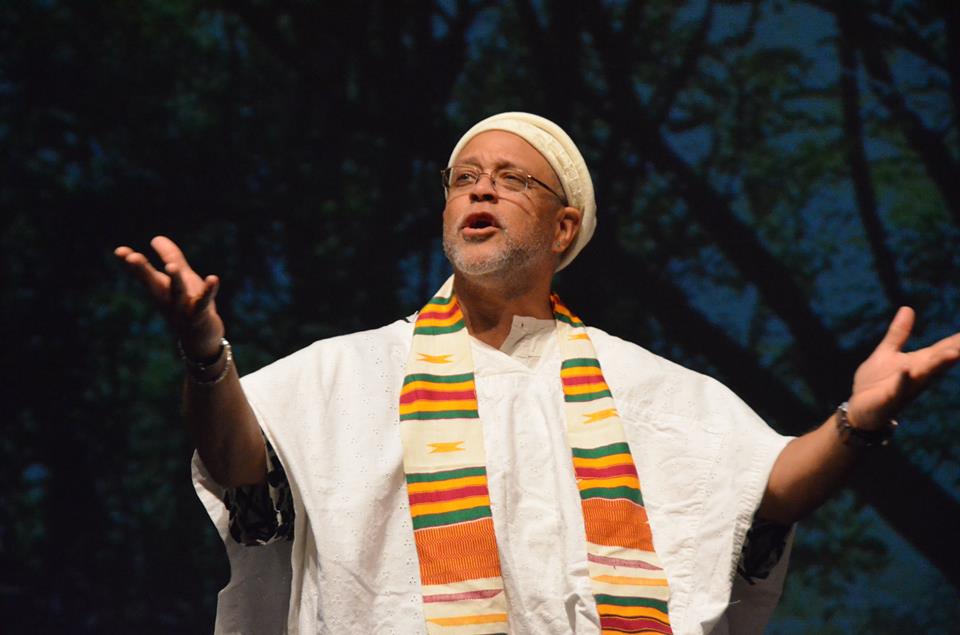
Súle Greg Wilson grew up in a Washington, DC that still had street musicians downtown, unfenced railroad tracks, and raccoons in the back yard; in a world of international experiences and local affairs, beloved relatives and guests from all over the globe who came and shared at the kitchen table. He was saturated in ancestral tales of far-away lands, practical lessons on street-wise ways, and discussions on politics and pop culture–then went out and experienced it, himself.
Súle is a polymath, a skilled musician who brings the rhythm of African and African-American music and culture into the spiritual practice he has shared with his students and audiences over decades in concerts, classrooms and lecture halls. He is also a writer and the author of seven books and “Keep a Song on Your Soul, an award-nominated stage piece. He has produced videos and numerous albums.
“Part Peter Pan and part Pied Piper…Wilson is more than an artist and a scholar. He has the rare ability to transcend race and age barriers through the use of his festive mood and rhythm. He uses dance and drums to evoke the energy and spirit that binds and connects all mankind. Young and old, black and white, the audience as a whole was captivated by this energetic and imaginative teacher.” (Flint Courier)
Teaching and Connecting
Súle has decades of classroom and lecture hall experience. He has developed (and been paid for) the many tools he has used to mediate and contextualize his experiences and understanding of Spirit moving in the world: the written word, storytelling, teaching history (local to World), photography, culture-based movement—including studies in martial arts, reiki, meridians, Kemetic arts, yoga, African and Post-African dance—spiritual practices from East, West, and South, and music (percussion, banjo, voice, ukulele).
Music
Súle was the catalyst for the creation of the groundbreaking Carolina Chocolate Drops, but he moves easily across genres. and has performed performed/recorded folk, blues, jazz, and world music. He has worked with Babatunde Olatunji and the International Afrikan-American Ballet, Tam Tam Mandingue & Ju Ju Bey, Mike Seeger, Joe Thompson, Bob Carlin, Alice Gerrard, Tony Trischka, Taj Mahal, Ruthie Foster, Guy Davis, Abraham Laboriel, LeRoi Jenkins, Time of Pastiche/Conjunto de Colores, and more.
Sankofa Man
Native Akan speakers shared with me the meaning of the word, “Sankofa”, as, “Go Back and Fetch It!”—do not move forward in your life without reaching back to bring the good from the past with you. That word—and its Adinkra symbol of the bird moving forward whilst reaching back to touch its tail—is shorthand for the proverb, “Se wo were fi na wosankofa a yenkyi”. In translation, that means: “It is not wrong to go back for that which you have forgotten.”
Though I do not recall when I first heard that term, Sankofa, my family culture was such that I was raised in the midst of that principle of reflecting upon and mining the past as a tool for future success. My maternal grandfather and great-grandfather were educators and “race men”; from my parents and extended family came tales of memorable characters on both sides; I learned therein was power. Also, I was innately interested in the “how come” and “from whence” of things—my prepubescent desire to be a paleontologist (“fossils and rocks!”) was replaced with hunger for cultural expressions: story, song, dance, and music carrying the hopes and history of a people. My first paycheck—at thirteen years old—was for folkloric presentations. I have been learning and sharing—and living—Sankofa ever since.